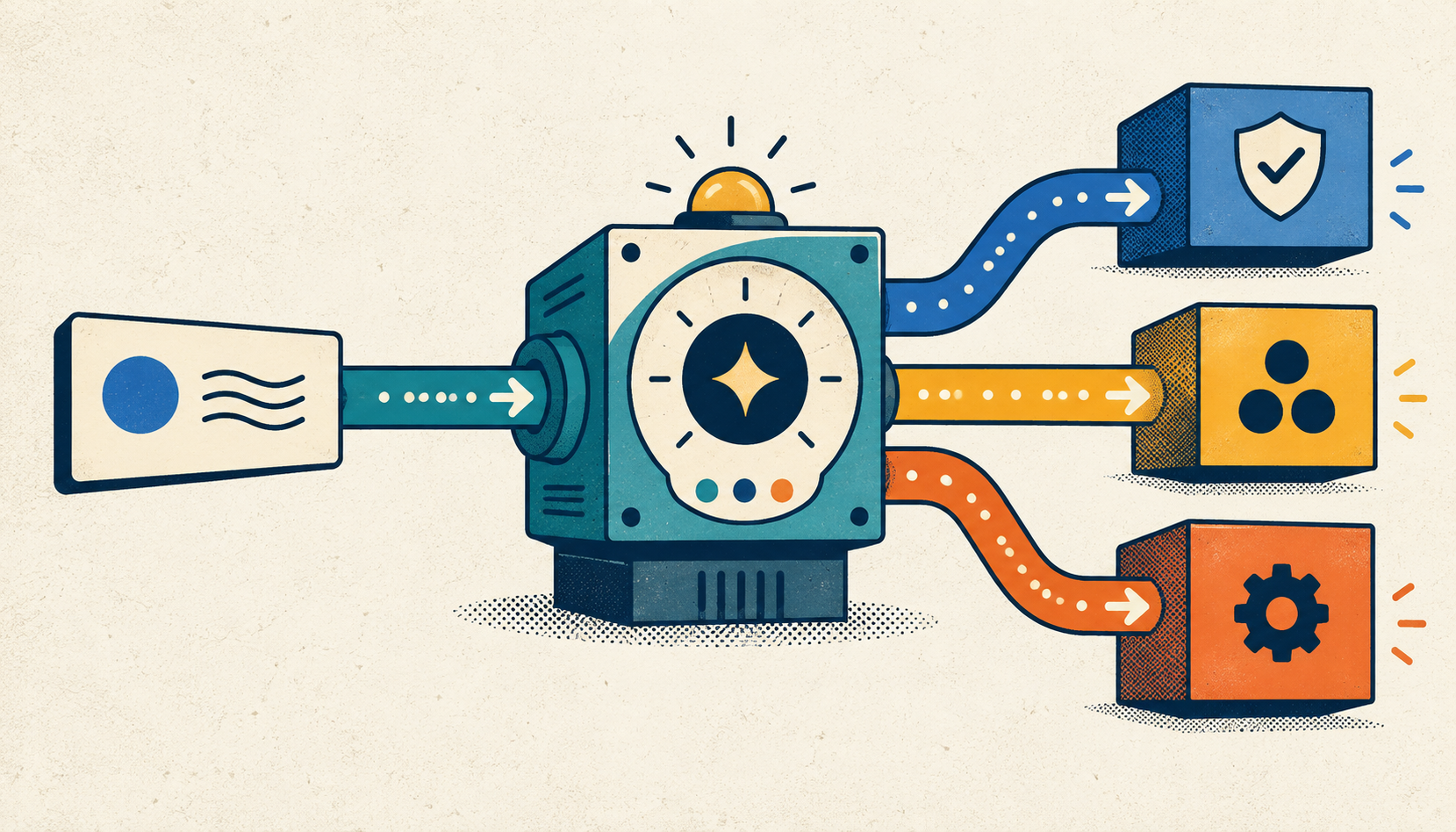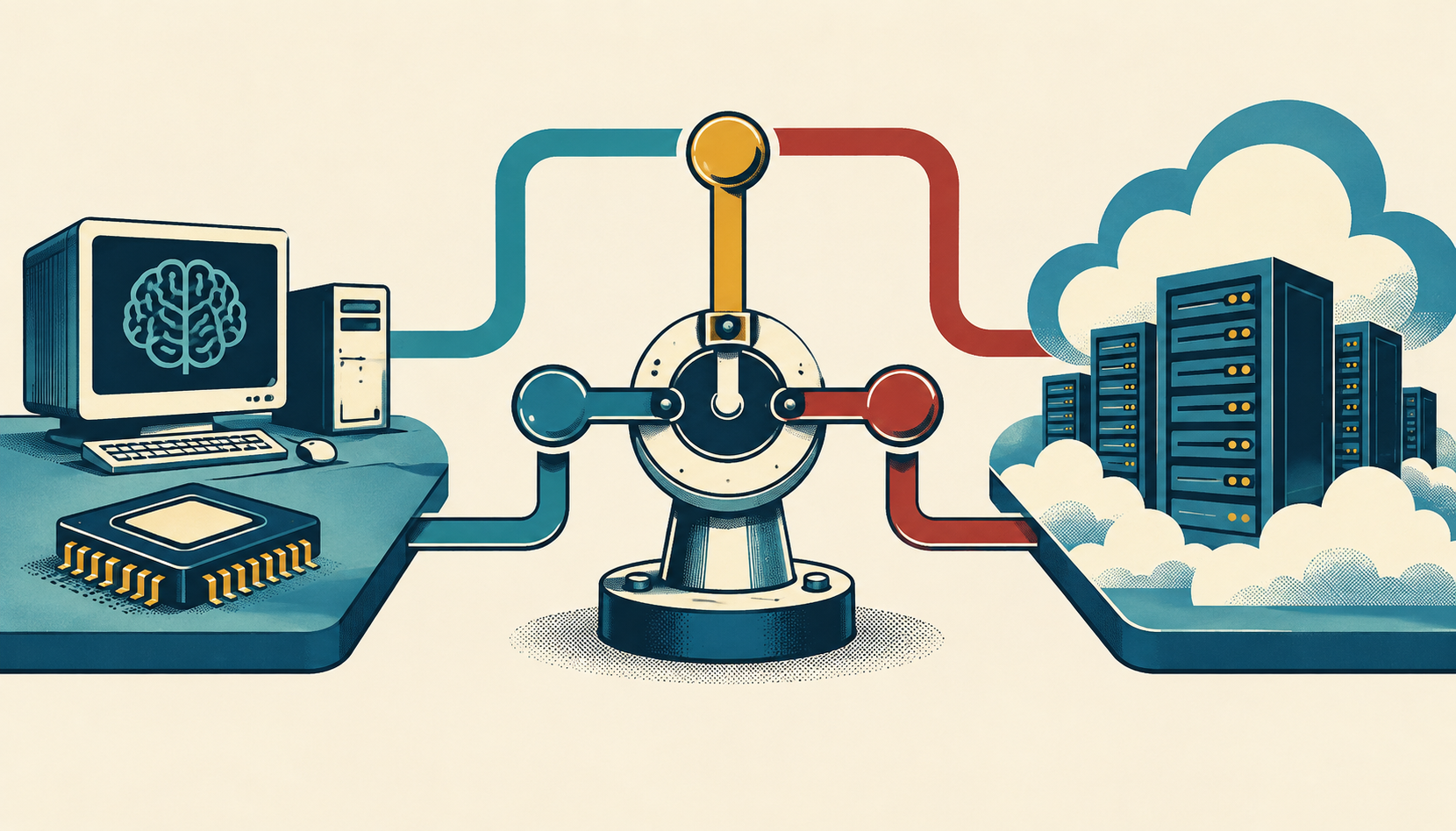
AI agents are moving toward a more practical architecture: keep routine and sensitive work close to the user, then escalate only the step that genuinely benefits from a cloud model, live web access, or a connected application. This local-first approach answers a question that broad "local versus cloud" comparisons often miss: where should each step of an agent workflow run?
The answer is rarely "everything on-device" or "everything in the cloud." A better design assigns a boundary to every step, records why that boundary was chosen, and asks for approval before data or authority crosses it. That makes local-first AI useful for privacy-conscious developers, IT and security teams, and operators who need accountable automation rather than a black box.
What local-first AI agents actually do
A local-first agent begins with a local model, local files, or a local tool runtime. It can classify documents, summarize an internal folder, draft a response, extract fields, or prepare a plan without sending the underlying data to a provider. If the task requires current information, a larger reasoning model, browser automation, or a connected business system, the agent proposes an escalation for that specific step.
This is different from treating a local model as a smaller replacement for every frontier model. The local component is a policy and execution boundary as much as it is a model. It decides what can be done privately, what requires a capability the local environment does not have, and what needs a human decision before it proceeds.
That pattern is becoming easier to implement. Perplexity describes its Portable Computer as a local harness with local models and approval before routing a step to cloud models; its launch explanation points to current information, browser use, connected apps, and advanced reasoning as reasons to escalate. NVIDIA positions DGX Spark as a desktop platform for local autonomous agents, while its documentation includes local-agent and air-gapped deployment guidance. Google Gemma 4 12B is documented for offline execution on Apple Silicon and a local OpenAI-compatible API in the developer guide. These examples show the direction of the market, but they do not make local-first universally better.
Why the local-first trend matters now
AI adoption is broad, but dependable agent deployment is still early. The Stanford AI Index 2026 reports 88% organizational AI adoption while agent deployment remains in the single digits across most business functions. That gap is partly a control problem. A team may be comfortable with an assistant answering questions, yet hesitate when an agent can read confidential material, browse on its own, or change records.
Local-first design narrows that trust gap by making the workflow legible. A team can say: customer records stay local; public pricing research may use the web; a cloud model may receive a redacted task after approval; sending an email always requires a person. Those rules are easier to review than a general promise that an AI system is "secure."
It can also reduce unnecessary latency, bandwidth, and cloud-token use for repetitive work. The trade-off is operational: local models need suitable hardware, updates, monitoring, and a fallback plan. The right goal is not maximum local execution. It is the smallest safe data and authority boundary for each job.
Use five questions to place each workflow step
Before choosing a runtime, score the step itself. These five questions produce a more durable policy than choosing a provider first:
- How sensitive is the data? Confidential files, personal information, credentials, and regulated records should default to local processing or a tightly controlled private environment.
- How fresh must the answer be? A static internal procedure can run locally. Today's market price, a new regulation, or a live incident may require approved web or cloud access.
- How difficult is the reasoning? Extraction and classification may fit a local model. Ambiguous synthesis or a long multi-document analysis may justify a stronger model, if the input can be minimized or redacted.
- How important is latency? A local response can keep an interactive workflow responsive and continue during an outage. A cloud call may be acceptable when quality matters more than immediate response.
- What happens if the agent is wrong? A draft is lower risk than changing a production record, moving money, or contacting a customer. External actions should require stronger controls than analysis.
A practical local-versus-cloud decision matrix
Classify or redact a confidential file
- Preferred execution: Local
- Reason: Minimizes exposure before any escalation
- Control: Keep the original local; log the transformation
Summarize an approved internal knowledge base
- Preferred execution: Local or private runtime
- Reason: Stable context does not need public web access
- Control: Restrict file scope and retain a receipt
Check current public information
- Preferred execution: Cloud/web escalation
- Reason: Freshness and retrieval are the main requirements
- Control: Send only the minimum query; cite sources
Resolve a difficult, non-sensitive reasoning task
- Preferred execution: Cloud escalation
- Reason: A stronger model may improve quality
- Control: Redact inputs and require step-level approval
Write to a CRM, deploy code, or send email
- Preferred execution: Human approval
- Reason: The risk comes from external authority, not model size
- Control: Preview the exact action and record the approver
The matrix is a starting policy, not a static answer. Revisit it when the data classification changes, a tool gains new permissions, or a local model's quality and resource requirements change.
What an approval-aware escalation looks like
A useful approval prompt should expose the boundary crossing in plain language. For example:
- Local step: "I found 14 relevant contracts and removed names, account numbers, and signatures."
- Proposed escalation: "Use a cloud model to compare the redacted clauses because the local model marked the renewal language as ambiguous."
- Data sent: "Only the redacted clause excerpts and the comparison question."
- Expected result: "A draft comparison with citations; no records will be changed."
- Next approval: "Review the draft before it is written to the contract system."
This flow gives the operator a meaningful choice instead of a generic "allow access" button. The system should preserve a receipt containing the step, data class, destination, reason, model or tool used, result, and approver. Receipts make troubleshooting and compliance reviews possible without requiring the team to reconstruct an agent's hidden reasoning.
How to implement the pattern without overengineering it
Start with a small number of explicit policies. Define which data must remain local, which tools are read-only, which destinations are permitted, and which actions always require approval. Then separate the agent into a local planner, a policy check, an optional escalation adapter, and an action gate. This separation lets a team improve the model without silently changing permissions.
Use data minimization at the handoff. Redaction, field-level filtering, short-lived credentials, and query-specific context are more useful than sending an entire workspace "just in case." Treat the cloud request as a new security event, not as a transparent continuation of local work.
Finally, measure the workflow rather than just model quality. Track how often an escalation was proposed, approved, denied, or unnecessary; how much context crossed the boundary; how often a human corrected the result; and which steps still fail locally. Those measures tell you whether the hybrid design is actually reducing risk and friction.
When local-first is the wrong default
Local execution is not automatically safer or cheaper. A poorly maintained device can be less secure than a well-governed hosted environment. A small local model may produce confident errors that a cloud model would catch. Hardware procurement, patching, observability, and model updates also carry cost. If a workflow needs a current external system, high-scale processing, or a capability unavailable locally, forcing it to stay on-device can make the system slower and less reliable.
The practical principle is reversible escalation: keep private work local when possible, reveal only what the next step needs, ask before crossing a meaningful boundary, and keep the action reversible until a person approves it.
Sources
- Perplexity Portable Computer and launch explanation.
- NVIDIA DGX Spark and release notes.
- Google Gemma 4 12B developer guide.
- Stanford AI Index 2026: Economy.
FAQ: local-first AI agents
Can an AI agent run locally and use the cloud only when needed?
Yes. A local runtime can handle private or routine steps and request permission for a specific cloud, web, or connected-app operation. The policy must define what data may leave the device and which actions require approval.
What should stay on-device?
Default to local handling for credentials, personal data, confidential documents, raw customer records, and intermediate context that is not needed for the next step. If escalation is necessary, redact or minimize the payload first.
Does local-first mean never using frontier models?
No. It means using stronger hosted models selectively, when their freshness, reasoning, or tool access justifies the boundary crossing. The decision belongs to the workflow policy, not to a blanket preference for one model location.
What is the most important control?
Make the proposed escalation visible and specific: show the data, destination, purpose, expected result, and next action. Then record the decision in a receipt that the team can audit.
Next step: design the boundary before choosing the model
Local-first AI agents are best understood as accountable workflows. Map the data, freshness, reasoning, latency, and action risk of each step. Keep the default path private and local where it makes sense, escalate narrowly when a cloud capability adds real value, and reserve consequential actions for explicit human approval. That framework will remain useful even as models, chips, and platforms change.